




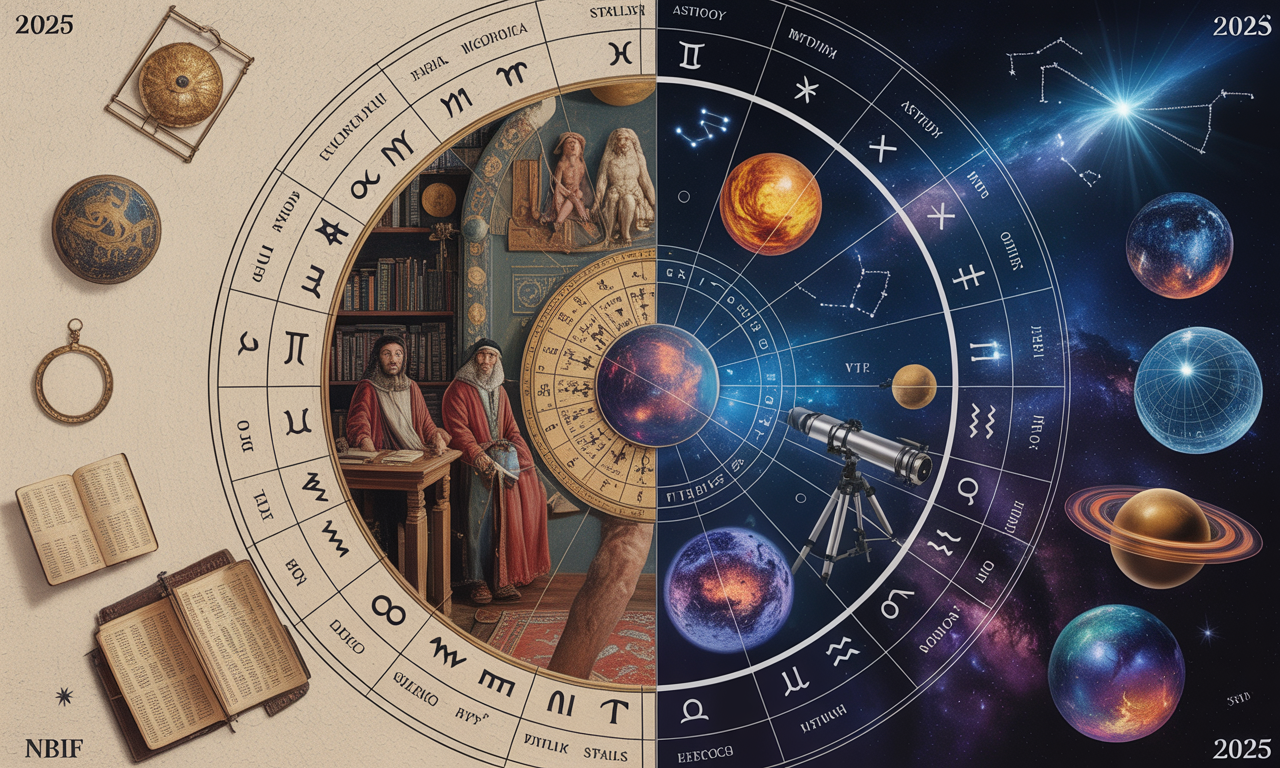
For thousands of years, humanity has looked to the night sky, weaving stories and seeking guidance from the stars. Astrology, far more than a modern pop culture phenomenon, is an ancient practice deeply intertwined with the evolution of civilizations. Its roots stretch back to Mesopotamia’s ziggurats, Egyptian temples, and Greek philosophical treatises. Over millennia, astrology has adapted, incorporating diverse cultural insights and transformations, from the Babylonian omens etched on clay tablets to the AI-powered horoscopes of 2025. Today, astrology continues to inspire seekers worldwide, from the AstroTwins and Cafe Astrology to emerging voices like Chani Nicholas and Nui Cacao, reflecting a timeless human quest to understand our place in the cosmic dance.
The Ancient Foundations of Astrology: Babylonian and Egyptian Contributions
The dawn of astrology emerges vividly in ancient Babylon around 2000 BCE, where priests documented the heavens on clay tablets, marking the beginning of a sacred dialogue with celestial divinities. Their early zodiac included 18 signs, which later refined to the familiar 12, symbolizing seasonal patterns essential for agriculture and governance.
- Babylonian astrologers observed planetary movements of Jupiter and Venus, associating them with earthly events like floods and victories.
- The Enuma Anu Enlil tablets served as foundational records, blending astronomy with omen interpretation.
- Egyptian priests introduced the concept of decans: 36 star groups guiding their calendar and spiritual practices, famously depicted in the Dendera zodiac.
- For Egyptians, astrology was intimately connected with the divine journey of the soul, offering guidance not just for life but also for the afterlife.
These intertwined systems laid down the structural and symbolic basis for astrology, blending science, spirituality, and societal needs into a coherent cosmic worldview. It was not an exercise in superstition but a meaningful interaction with the universe’s rhythms.
The Legacy of Babylonian and Egyptian Astrology in Modern Times
Modern systems such as those featured on websites like Astrology.com and AstroSeek draw on these ancient roots, continuously refining interpretations for contemporary audiences. The enduring emphasis remains on correlation between celestial cycles and human affairs, reflecting a lineage that spans over 4,000 years.
Greek and Roman Expansion: Philosophical Refinement and Political Power
By the 4th century BCE, Greek thinkers synthesized Babylonian-Egyptian astrology with their own cosmological theories, infusing it with philosophical depth. Claudius Ptolemy’s Tetrabiblos, penned in the 2nd century CE, codified astrology’s foundations for the Western world, crafting a tropical zodiac aligned with seasons rather than fixed stars.
- Introduction of planetary rulershipsfor example, Mars presides over Aries, Venus over Libra, creating archetypal associations.
- Development of the elemental system of fire, earth, air, and water influencing personality traits and chart interpretation.
- Roman emperors, like Augustus, used astrology as political symbolism, reinforcing their authority by showcasing their zodiacal signs on coinage and public imagery.
- Astrology’s integration into Roman society ranged from imperial courts to the daily lives of citizens across the empire.
This cultural embedding ensured that astrology was both a practical tool and an intellectual discipline, influencing personal identity and statecraft alike. The resonance of these Greco-Roman principles continues to shape platforms like The Astrology Zone and AstroStyle, which bring ancient wisdom into the digital age with accessible guidance.
Philosophy Meets the Stars: Illustrated Example from the Renaissance Era
Imagine a Renaissance astrologer’s chart, divided into twelve houses representing life domains such as career and relationships, analyzed through planetary positions. Saturn’s dominance in the 1st house might hint at disciplined ambition, while its challenging aspects with the Sun suggest internal struggle, a blend of symbolic narrative and detailed observation.
Medieval Stewardship and Islamic Golden Age: Preserving and Advancing Astrology
While Europe experienced the Dark Ages, the Islamic world championed astrology’s study and preservation. Scholars in Baghdad’s House of Wisdom translated Greek texts and merged them with Arabian innovations.
- Al-Biruni and Abu Ma’shar introduced complex mathematical and metaphysical layers to the craft.
- Albumasar’s The Great Introduction to Astrology connected planetary aspects and human destiny.
- This scholarship later inspired Europe’s Renaissance revival, ensuring continuity and enrichment of astrological knowledge.
These intellectual exchanges reveal astrology as a resilient, evolving discipline, finding fertile ground across cultures and centuries. Contemporary astrologers like Astrology with Heather and Tarot.com honor this heritage, blending tradition with modern spiritual exploration.
Modern Astrology in 2025: From Skepticism to Spirituality and Digital Engagement
The Enlightenment’s emphasis on scientific rigor relegated astrology to the fringes, yet it reasserted itself in the 20th and 21st centuries as a tool for psychological insight and personal growth rather than deterministic prediction.
- Dane Rudhyar shifted astrology’s focus toward self-discovery, emphasizing free will over fatalistic prophecy.
- Today, astrology thrives online through apps and websites like Cafe Astrology and Chani Nicholas’s platforms, enabling precise natal chart analyses and transit interpretations.
- Transit readings, such as Jupiter illuminating one’s second house of finances, encourage proactive life choices.
- Celebrity astrologers and resources provide accessible, nuanced content that bridges the ancient and contemporary worlds.
This renaissance proves astrology’s versatility as a mirror for reflection and a catalyst for personal transformation, rooted in ancient knowledge yet dynamically engaging with 21st-century seekers.
A Global Tapestry: Diverse Astrological Traditions and Their Modern Resonance
Astrology’s diverse paths reflect cultural identities and philosophies, each offering unique insights yet sharing the core premise of cosmic-human connection.
- Western astrology: Emphasizes the tropical zodiac with psychological depth, often explored on platforms like AstroSeek and The Astrology Zone.
- Vedic astrology (Jyotish): Employs the sidereal zodiac and 27 nakshatras, focusing on karma and dharma, enriched by centuries of Indian tradition.
- Chinese astrology: A lunar calendar system revolving around 12 animal signs and five elements in 60-year cycles, deeply influencing personality and timing.
Each tradition sustains a living dialogue between the heavens and human experience, inspiring practitioners worldwide from Nui Cacao to Tarot.com.
Astrology’s Cultural Imprint Beyond Divination
Astrology permeates literature, psychology, and popular culture:
- Shakespeare’s allusions highlight its narrative power amid skepticism.
- Carl Jung incorporated planetary archetypes into psychoanalysis, enriching the understanding of human psyche.
- Contemporary media frequently references zodiac signs, underscoring astrology’s enduring influence.
Such cultural integration reinforces astrology’s role as a symbolic language, less about causal proof and more about meaningful interpretation.
Engaging with Skepticism: Astrology as Symbolism and Reflection
Despite scientific challenges, astrology’s proponents argue it functions as a symbolic system rather than empirical science. Critics cite issues like the precession of the equinoxes and the Barnum effect, questioning astrology’s validity.
- Precession shifts constellation positions, yet astrology’s tropical zodiac focuses on solar seasons.
- The Barnum effect reflects psychological tendencies to find personal meaning in vague statements.
- Astrologers emphasize interpretation, viewing the zodiac as a map of meaning enriched by the elements and modalities.
This perspective invites astrology as a tool for self-exploration rather than deterministic fate, a theme embraced by modern voices such as Chani Nicholas and Astrology with Heather.
Astrology’s Enduring Legacy: A Bridge Between Cosmos and Consciousness
Tracking astrology’s journey from Babylonian astronomers to 2025’s digital stargazers demonstrates its remarkable resilience and adaptability. It continues to serve as a cultural compass and personal guide, stitching human stories into the grand celestial template.
- Astrology invites us to ponder not only where the planets are but how their symbolic language reflects our inner worlds.
- As Ptolemy wisely advised, “the stars incline, but do not compel,” underscoring the balance between destiny and free will.
- Whether quantified or mystical, astrology’s place in 2025 remains vibrant, engaged, and deeply human.
Exploring astrology is to explore an ancient, evolving story of humanity’s enduring quest to find meaning in the cosmos above and within.